Kanban Board Simulation Game
For teams and organizations looking for a hands-on, engaging way to explore Kanban principles, the Kanban Board Simulation Game offers a valuable starting point. While we do not use this game in our own training programs, we recommend it as a freely available tool that enables participants to experience key elements of Kanban — such as flow, WIP limits, and collaboration — in a playful and interactive setting. It’s a simple yet effective way to gain practical insights into how Kanban systems work.
Experience Agility Playfully
Kanban is everywhere nowadays – but let's be honest: how many teams actually use it effectively and with intention? Often, boards are just put up without the team truly understanding the dynamics behind workflows, bottlenecks, and process improvement.
That’s where this Kanban board simulation comes into play. In this article, I'll show you how to experience Kanban in action with a simple game and what you can take away from it.
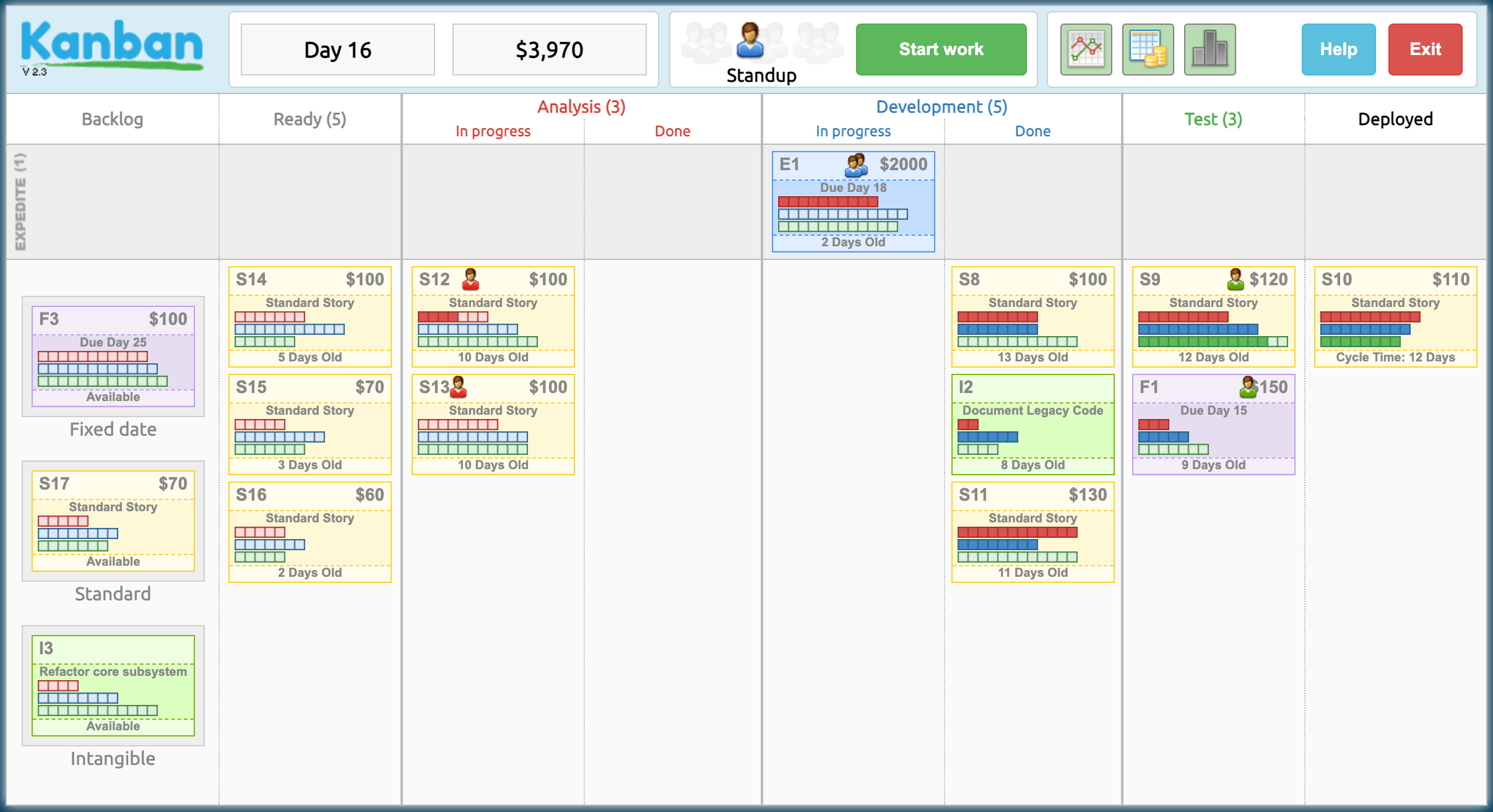
Source: kanbanboardgame.com - Overview - main game panel
This game provides a "relatively realistic" Kanban simulation of a software development team's daily routine, in which they develop a fictional product. The more features that pass through the Kanban process and are implemented, the more paying users can be acquired.
The goal of the game is to generate as much value (money) as possible within a certain number of days (turns). With each completed work package, you earn money every day.
TEAM DISCIPLINES
The simulation includes three different disciplines within the fictional team Analyst (red), Developer (blue), and Tester (green). These team disciplines correspond directly to the process steps "Analysis," "Development," and "Test" on the Kanban board.
The team can be reassigned each day to help move tasks in progress toward completion. It’s also possible to assign multiple team members to a single task. Team members are assigned by dragging them onto the work items once that’s done and the “Start work” button is clicked, they begin working.
The team’s productivity is randomly generated each round to keep the simulation realistic. If team members work outside their area of expertise (e.g., a Tester doing analysis), their productivity is halved. Still, assigning team members to unfamiliar tasks can be a smart move to reduce bottlenecks and keep the flow going, just like in real teams, where people support each other and, for example, developers jump in to help with testing when the workload piles up or too few testers are available.

Source: kanbanboardgame.com - Head panel with available team-members
CLASSES OF SERVICE
Another interesting aspect of the simulation is the different classes of service that regularly appear in the backlog:
- Standard User Stories (yellow): Expand functionality and generate value for users.
- Fixed Date (purple): Have a defined maximum delivery date and must be completed by then.
- Intangibles (green): These tasks do not bring immediate value or new customers but must be completed to ensure the team can work more efficiently in the future, such as reducing technical debt or expanding infrastructure.
- Expedites (blue): Unforeseen urgent tasks that appear out of nowhere and use the Expedite swimlane (grey row) at the top of the Kanban board for completion. These tasks often have high value or severe penalties if not completed.
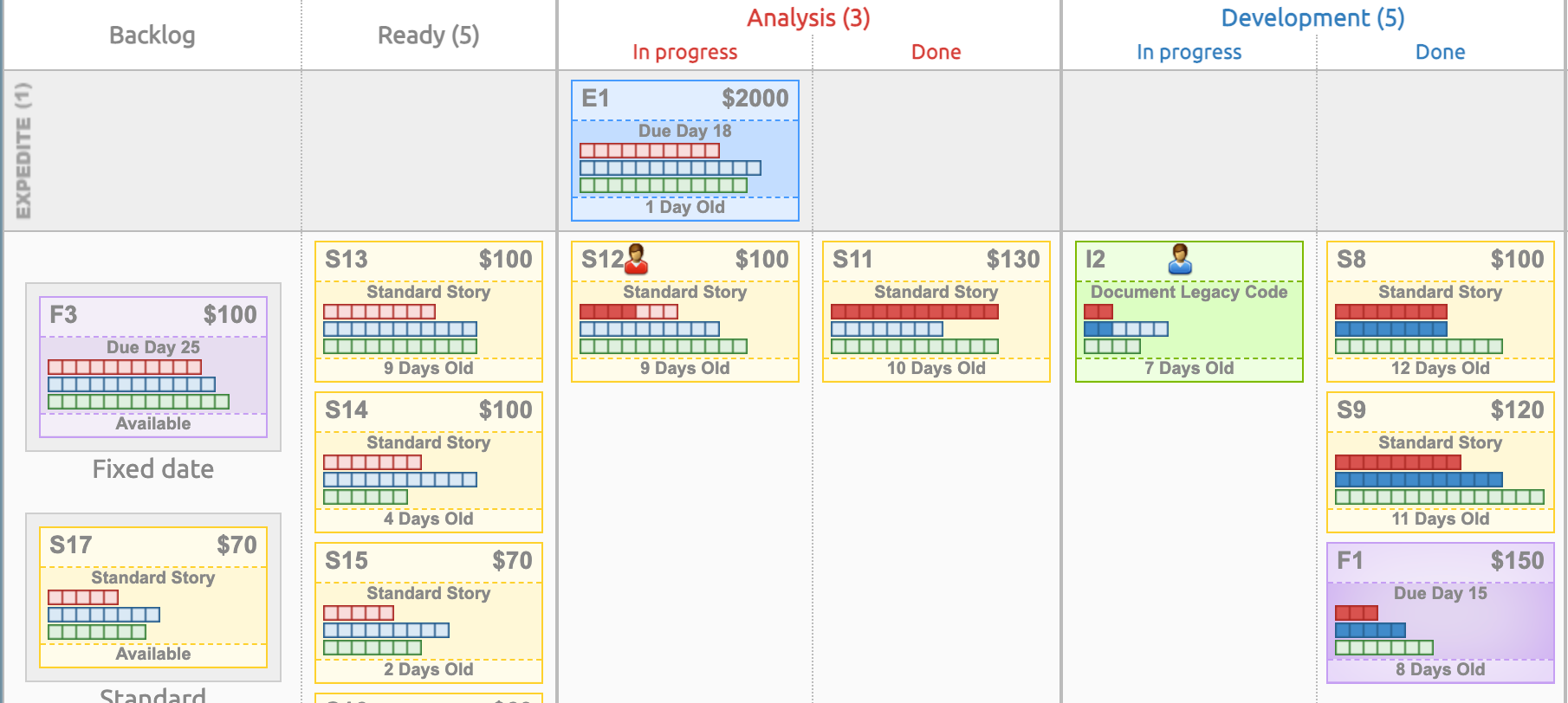
Source: http://www.kanbanboardgame.com/ - Different classes of service, colour coded
Kanban Classes of Service (CoS) help categorize different types of work based on factors like urgency, risk, or expected delivery time. This classification enables teams to quickly recognize and handle time- sensitive or high-priority items, making sure that critical work gets the focus and attention it needs.
GET TO WORK
Now it’s time to put your team to work and distribute them across the available tasks to maximize flow and value. Each day, you’ll drag and drop your team members onto the work items you want them to tackle.
Pay close attention to the WIP limits, you can only move a task from “Done” to the next column at the start of a day, and only if there’s space in that column.
Also consider the classes of service:
- Is there an Expedite item that requires immediate attention?
- Are there Fixed Date items that must be completed on a specific day?
- Which tasks can realistically be finished within one round?
- Where might it make sense to assign multiple team members to speed things up?
Try to keep everyone engaged — an idle team member is a missed opportunity for progress. A well-balanced assignment not only helps avoid bottlenecks but also keeps the workflow smooth and efficient.
Pro Tip: Don’t just think one move ahead — start anticipating constraints a few turns in advance to avoid surprises. What happens if testing is full tomorrow? Will a blocked Analysis column slow you down later? The better you plan ahead, the more value you’ll generate over time.
END OF DAY
At the end of each workday, you receive a summary of the day, along with reminders and sometimes random events like vacations, illnesses, and other disruptions that can occur during a workday.
If you play the game multiple times, you'll notice that there is actually a fixed set of events that occur in a certain sequence but this does not significantly impact the gameplay experience.
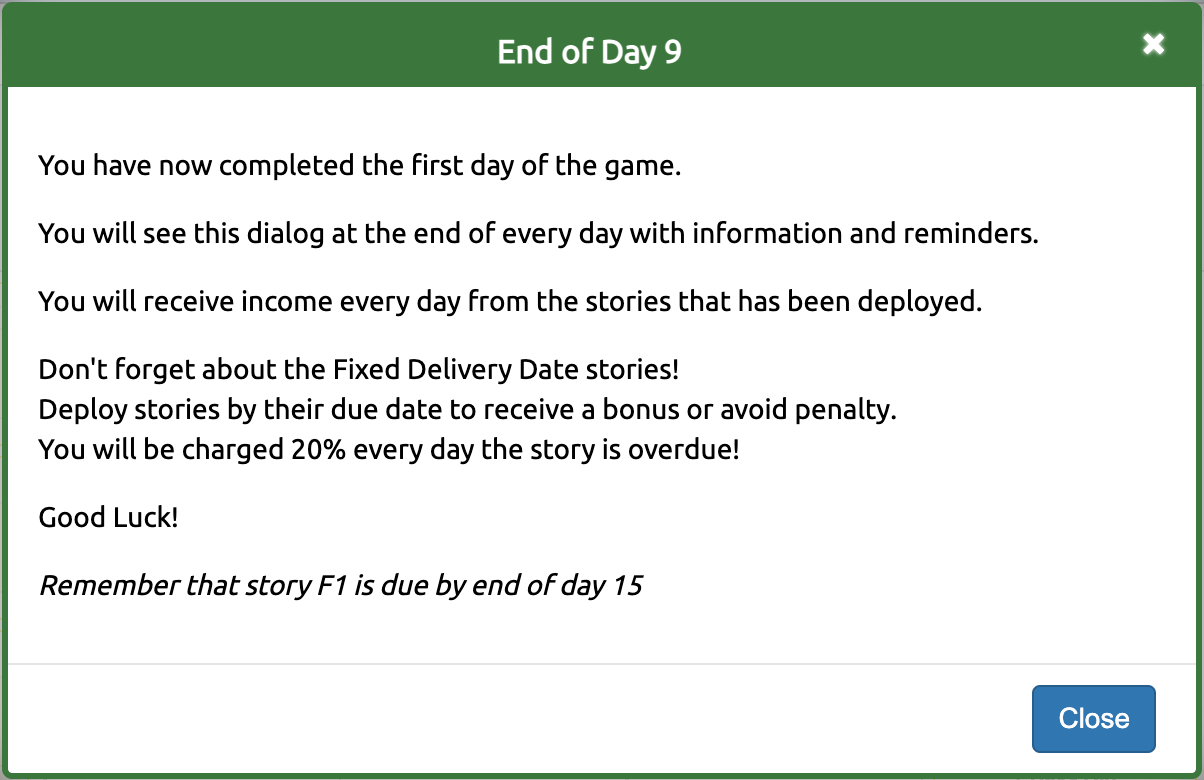
Source: http://www.kanbanboardgame.com/ - Summary of the day
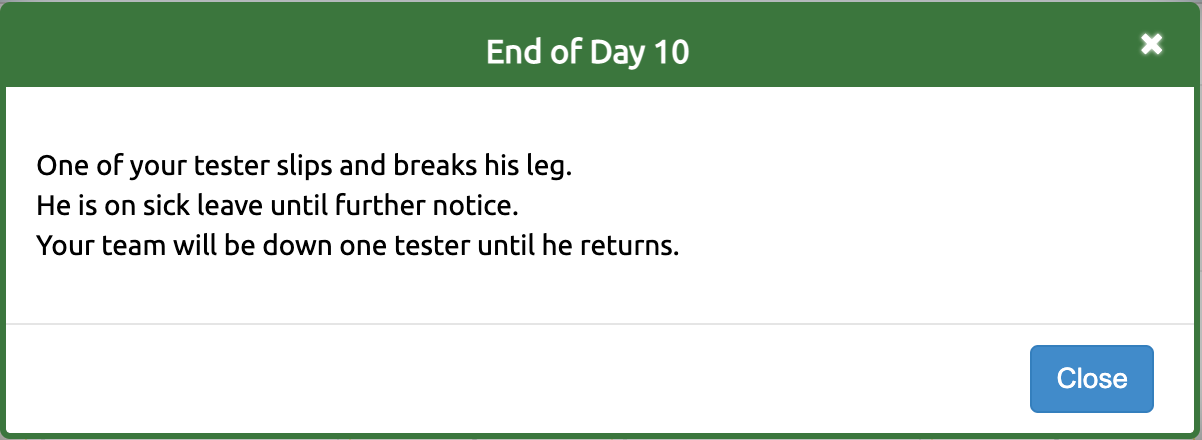
Source: http://www.kanbanboardgame.com/ - Random event
METRICS & ANALYSIS
To track your progress and assess the throughput of tasks in your Kanban board, the game offers valuable basic metrics and charts.
For example, the Cumulative Flow Diagram in Kanban visualizes the amount of work in each state over time, essentially showing how many tasks are at each stage at any given time. This can help identify bottlenecks.
Another key metric is Cycle Time, which shows how long, on average, a task takes to complete, from the moment work begins until it is delivered.
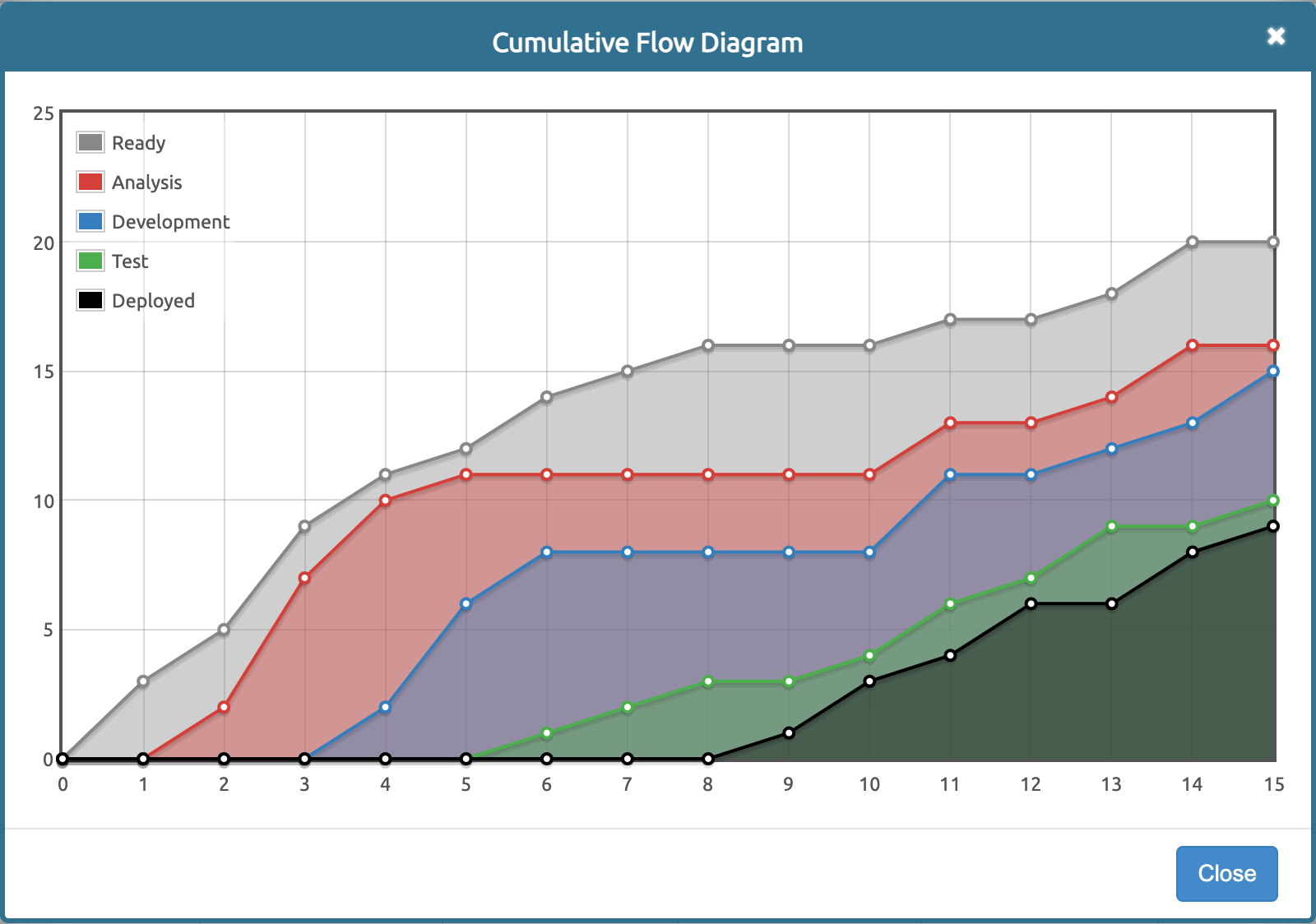
Source: http://www.kanbanboardgame.com/ - Cumulative Flow Diagram
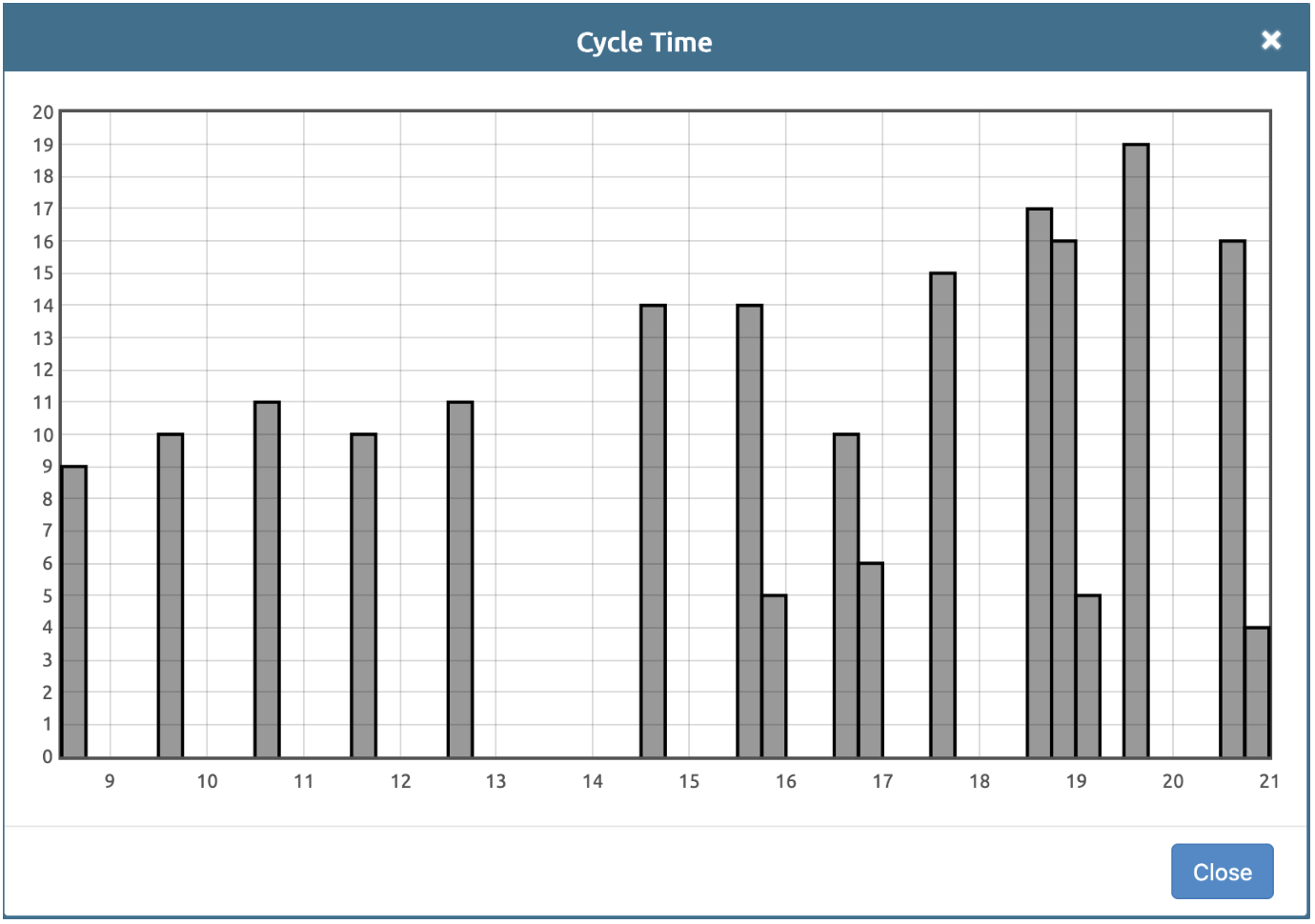
Source: http://www.kanbanboardgame.com/ - Cycle Time chart
THE CHALLENGE
The core challenge of the game lies in smartly prioritizing individual work packages while balancing value, effort, and urgency. The way tasks are ordered directly influences the total value your team can generate.
To make things more interesting (and realistic), you also need to respect Kanban-specific WIP (Work in Progress) limits for each process step:
- Ready (5)
- Analysis (3)
- Development (5)
- Test (3)

Source: http://www.kanbanboardgame.com/ - Workflow steps & WIP-limits
These limits prevent too many tasks from piling up in a single stage, helping to streamline the flow and avoid bottlenecks or delays.
As a logical and important side effect, WIP limits shift your workflow from a push system to a pull system, fostering smoother, more demand-driven progress.
TRY IT OUT
The Kanban board game ends on day 35, giving you 26 turns to optimize the task flow and generate as much value as possible.
It’s a great way for teams to engage with the fundamental elements of Kanban, develop a deeper understanding, and explore how to apply these principles in practice — all in a playful and low-risk environment.
Give it a try and see what insights it unlocks for your team!
Flow Sensei helps teams and leaders build systems that work with people, not against them. And if this article struck a chord, you’ll love our Kanban trainings — practical, engaging, and rooted in the real challenges teams face every day.

YES. We Kanban..
Certified Kanban Trainings
Improve flow in your organization with Kanban.
Our trainings are defined by an engaging and supportive learning atmosphere – shaped by experienced trainers who combine strong facilitation skills with deep, real-world expertise.
Through their ongoing work with teams and organizations, they bring broad insights and concrete examples that make the content relatable and memorable.